
David Bird Talks traffic management at Fieldays
It takes a small army to manage Fieldays traffic each year as upwards of 130,000 visitors drive in and out of the Mystery Creek venue over four days.
Traffic Management NZ has been in business for 17 years and for 16 of them they have been ensuring that all Fieldays traffic arrives at Mystery Creek safely.
When they started out, TMNZ had about 16 staff working for them, but today 40 of their 85 Hamilton-based staff are directing traffic to the Southern Hemisphere’s largest agricultural event.
General Manager David Bird said that one of the reasons for the increase in staff is due to fatigue management.
“The laws around work hours have changed and we can’t work more than what the log book is saying,” Bird said.
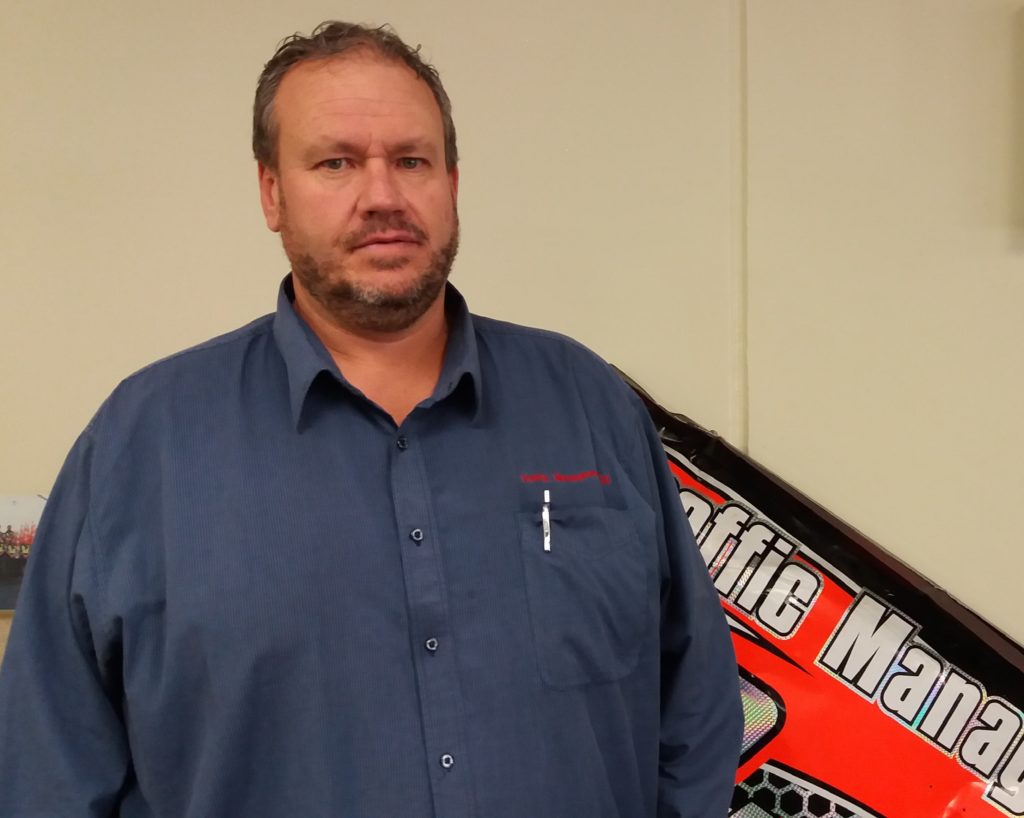
TMNZ General Manager David Bird has 40 staff members working Fieldays. Photo: Jesse King
“We can’t do any more of those long hours that we used to in the old days, so now we have quite a strict fatigue policy that we try and follow very hard.”
Bird has previously covered the event as a lead site traffic management supervisor and says that Fieldays is one of the biggest events TMNZ is involved in.
“We’ve been involved in other big events like triathlons and the V8’s of course, but Fieldays is a rather large event and it has a lot of people attending it,” he said.
Bird said the TMNZ team was made up of traffic controllers, STMS’s, events specialists and the branch manager.
“We put together a team, a little army of our traffic management guys to go out there and establish and install everything to ensure it all works and runs smoothly,” he said.
He said that one of the bigger challenges his team faces is giving motorists clear directions, because if they don’t, sometimes they’ll go the wrong way.
“In saying that, some motorists are just impatient,” Bird said.
“People don’t like being stuck in traffic jams, so they feel that maybe we’re there just to make their life hell, but we’re not, we’re there to try and help them get through.”
We're New Zealanders, we like to be able to drive right up and park at the gate.
The most common incident Bird has some across is people getting stuck.
“That’s really the challenge, moving cars that get stuck so it doesn’t clog the rest of the traffic flow up, but generally around Fieldays most people seem to move on.”
Bird said that Fieldays running a free shuttle to and from the event for ticket purchasers was “a good idea”.
“They should do more of it through the city and other big cities,” he said.
“More people using the park and rides is a good thing, but we’re New Zealanders, we like to be able to drive right up and park at the gate.”
Dean Kebbell on the old days and how things have changed
Company director Dean Kebbell says Fieldays management have spent a lot of time and resources on making sure they’ve done everything possible to make it easier for their visitors to get there.
“These days all the roads have sand on them and they’re well compacted,” Kebbell said.
“In the old days you’d be dragging cars out with tractors and all sorts.”
Kebbell knows a bit about the old days, he helped to make new plans for managing traffic at Fieldays when TMNZ were brought on board so many years ago.
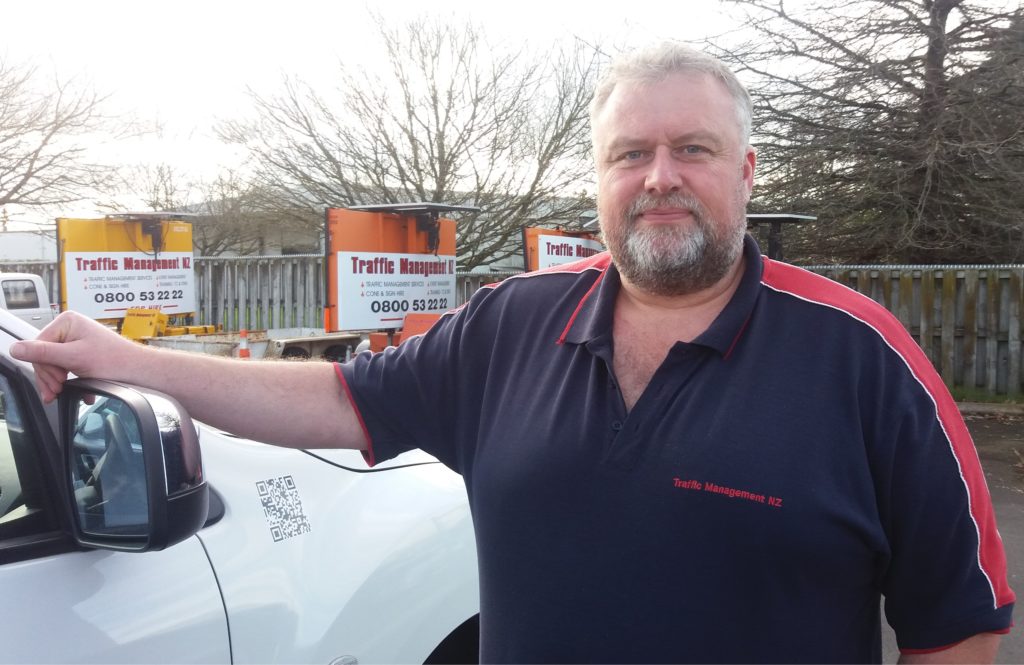
TMNZ company director Dean Kebbell has had some crazy experiences at Fieldays. Photo: Jesse King
“I suppose the number of people attending and a few changes to legislation and law regarding health and safety meant that they had an incident where they had a massive delay one year,” he said.
“So they had to sit back and say ‘crikey we need to deal with this.’ So that’s when they got us involved.”
He said it was a difficult task initially, walking into the situation cold and having to find out a lot of information in a short time.
He had meetings with police and Fieldays organisers to find out where peak traffic was coming from, what time it was peaking and where everybody was parking.
Another person involved was Leo Tooman who was the senior roading inspector at the time.
“He had a lot to do with it, him and I basically put together the very first plan and ran it for the first year and then tweaked it from there,” Kebbell said.
He said it hadn’t been hard to adapt to the event as it has grown, they just evolved with it by adding staff to the right areas and changing the set up of some of them.
One of those changes was putting signs up near Taupiri to split the traffic coming down state highway 3.
Another change was when a new roundabout was constructed south of Hamilton, leading to the city and the airport – it required TMNZ to look at managing that traffic a different way.
“Beforehand there were traffic islands and we just used to run the stop/go,” he said.
“The big thing for us is keeping the wheels turning, motorists get upset when they stop – even if they’re just crawling along they don’t mind too much because at least they can see they’re getting somewhere.”
In his time managing Fieldays traffic, Kebbell didn’t witness any serious accidents or road rage.
The helicopter landed and blew someone's cake up.
“Because it’s been going for so many years, road rage actually isn’t bad, people just expect it,” Kebbell said.
“People know that when you go to Fieldays you’re going to be sitting in a cue for a wee bit.”
But that’s not to say he hasn’t experienced some unusual situations in his time.
“We’ve had a bomb scare one year in the car park and had to helicopter in a bomb disposal squad from Rotorua,” Kebbell said
“The helicopter landed and blew someone’s cake up. It was cake in a tin or lunch in a tin that had fallen out of the car.”
His craziest experience at the event was when a visitor went into labour just as she was leaving.
“As soon as he heard, Leo informed myself that we needed to get her to the hospital, so we just used the boys to control the traffic and opened up a clear lane,” he said.
“Leo chucked her in his control car and they had a clear lane right out of the traffic.”
Kebbell said traffic around Fieldays was improving every year and that the only other thing that could be done to alleviate congestion would be to change the roading infrastructure.
“However, you can’t spend hundreds of thousands of taxpayer dollars creating a roading network that’s all geared around four days a year,” he said.
“There are other areas that the money needs to be spent.”


